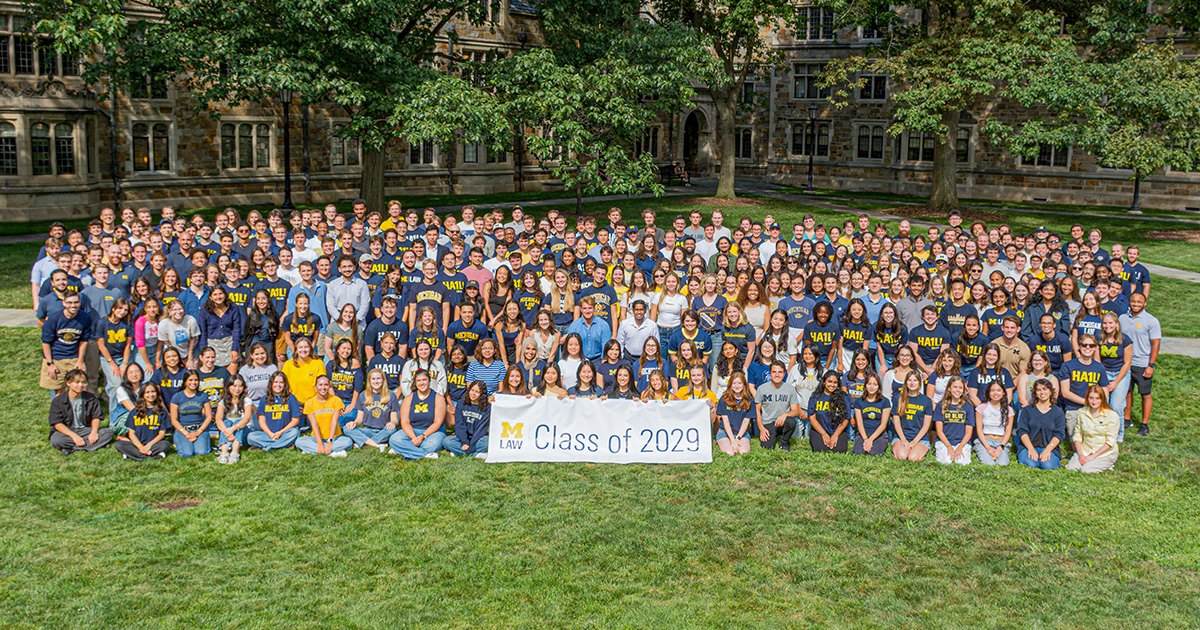
The University of Michigan Law School's incoming class posted the highest median LSAT score and GPA in school history, the school announced Thursday, Sept. 10.
The 322 students in the Class of 2029 carry a median LSAT of 172 and a median undergraduate GPA of 3.90, according to Michigan Law's announcement. The school also drew a record 9,118 applications.
The numbers land amid a national law school boom. Nationwide, 82,484 people applied to American Bar Association-accredited law schools in 2026, the highest total since 2010, Reuters reported Aug. 20, citing Law School Admission Council data. That marked an 8% jump over 2025, which itself saw an 18% surge.
What stands out in Ann Arbor is who is showing up. The class's median age is 25.5, the oldest in decades and possibly ever, according to Senior Assistant Dean Sarah Zearfoss. About 92% of the incoming students worked or pursued additional schooling before enrolling. A quarter worked as paralegals, which Zearfoss called likely an all-time high.
The school also saw an influx of former federal government employees. Among them: a senior judicial assistant to retired U.S. Supreme Court Justice Anthony Kennedy, an economic growth officer for Egypt and Liberia at USAID, and a special agent for criminal investigations at the IRS.
"A perhaps unanticipated silver lining for the recent shrinking of the federal workforce has been the enrichment of the law school application pool," Zearfoss said in the announcement.
Cameron Thomas, a former public health analyst at the CDC's National Center for Injury Prevention and Control, had his entire office laid off while he was studying for the LSAT. Meredith Johnston spent four and a half years as a surface warfare officer in the U.S. Navy, leading a division of 30 sailors. She is a citizen of the Chickasaw Nation of Oklahoma and plans to study environmental torts and federal Indian law.
Fatima Yahya, who was born in Iraq and fled as a child to Syria before entering the United States as a refugee, earned degrees in political science and philosophy with a co-major in peace and conflict studies from Wayne State University. She worked for Gov. Gretchen Whitmer as an issue specialist before enrolling.
Thirteen percent of the class are first-generation college students. For 15%, the JD will be a second or third advanced degree. The students represent 139 undergraduate institutions and 55 majors.
They come from 46 states plus Washington, D.C., and 20 countries. Michigan residents make up 19% of the class. Students range in age from 22 to 44, and their hobbies span from oyster farming to cave diving to Rubik's speed cubing.