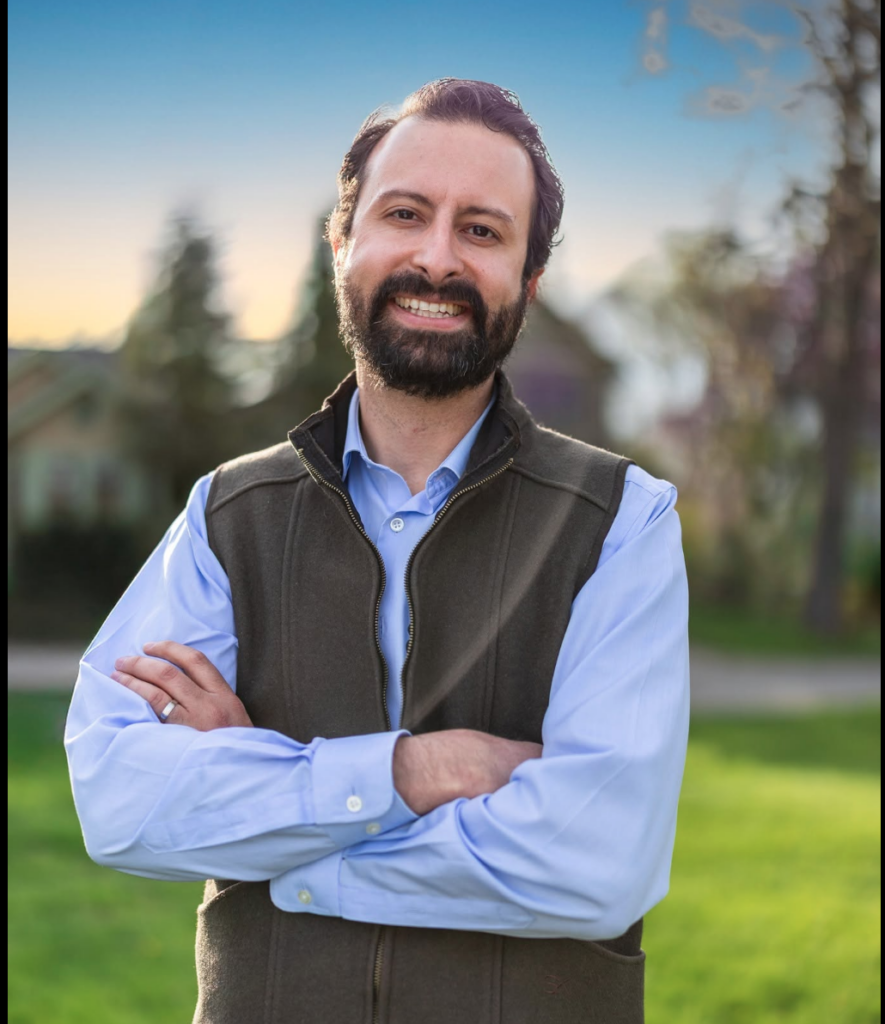
Washtenaw County Commissioner Yousef Rabhi will be Ann Arbor's next mayor after defeating 12-year incumbent Christopher Taylor in the Tuesday, Aug. 4 Democratic primary, capturing 55.4% of the vote and winning 49 of the city's 52 precincts in a result that drew nearly double the turnout of the last mayoral race.
Taylor conceded shortly after 11 p.m. on Aug. 4. With no Republican or independent candidate on the November ballot, Rabhi will run unopposed in the general election.
Rabhi told supporters at the Live nightclub downtown that the campaign proved the power of ordinary voters could overcome corporate money, calling the result unlike anything in Ann Arbor's political history. He thanked the crowd for being part of what he called an effort to take the city back for the people.
Unofficial results from the Washtenaw County Clerk show Rabhi received 18,746 votes to Taylor's 15,090, with all precincts fully counted. Voter turnout in the mayoral race hit 45.81%, up from 25.41% in the 2022 contest. County-wide turnout was 43.65%.
Taylor carried three of the city's 52 precincts, including 2-16 and 2-19 — both among Ann Arbor's wealthiest neighborhoods bordering the Huron River, the U-M Arboretum and Huron Hills Golf Course. The third precinct he won wasn't identified in available reporting.
A mandate, but a Taylor-aligned council
Rabhi's landslide did not extend down-ballot. Taylor-backed candidates won four of five City Council races on Aug. 4, according to MLive, leaving the incoming mayor facing a council majority aligned with his predecessor's agenda.
The winners: incumbent Cynthia Harrison in Ward 1 (61%), Sandy Aldrich in Ward 2 (62%), Aidan Sova in Ward 4 (57%) and incumbent Jenn Cornell in Ward 5 (56%). The lone Rabhi-endorsed victor was Ryan Bartholomew, a democratic socialist and legislative director for state Rep. Carrie Rheingans, who beat Taylor-backed Ashley Hall in Ward 3 with 53% of the vote.
That math matters. Nine of 11 council seats will be held by Taylor allies when Rabhi takes office, enough to override a mayoral veto, block appointments and control executive hiring, according to the A2 Independent.
Rabhi has already signaled he would veto any attempt to sell city-owned land, including the Kline's lot on Ashley Street, which Taylor's administration began negotiating to sell to a luxury housing developer. That deal has not yet come back for a final council vote.
What drove the result
The race centered on the Comprehensive Land Use Plan adopted unanimously by council in March 2026 under Taylor's leadership. The plan eliminated single-family zoning citywide and opened some residential neighborhoods to multi-story apartment buildings. Rabhi campaigned against the plan's scope and what he called poor citizen engagement in its adoption.
Taylor, first elected to council in 2008 and to the mayor's office in 2014, gathered with supporters at Bamboo restaurant on election night. "No one knew the size of that coalition. Now we do," Taylor said of the opposition vote, according to MLive.
Combined campaign spending reached approximately $400,000 in disclosed donations, not counting dark money spending by Michigan Deserves Better, a Lansing-based PAC with unknown backers that ran mailers and online ads attacking Rabhi's voting record. The Association of Realtors also sent mailers supporting Taylor.
What comes next
No Republican candidates filed for any council seat. The Aug. 4 primary winners are expected to begin four-year terms after the Tuesday, Nov. 3 general election. Independent candidates Kenneth Arthur Leicht Jr. (Ward 3) and James Trost (Ward 4) have filed; write-in candidates have until Friday, Oct. 23 to declare.
In a statement Wednesday, Aug. 5, Rabhi pledged that Ann Arbor would resist federal immigration enforcement and push back against rising inequality, positioning himself as a mayor who would use the office to confront both local development interests and federal policy.
The new council and mayor will take office in November facing immediate questions about the Kline's lot sale, the future of the Comprehensive Land Use Plan and whether a nine-member council majority will work with or against a mayor who won more than half the vote.