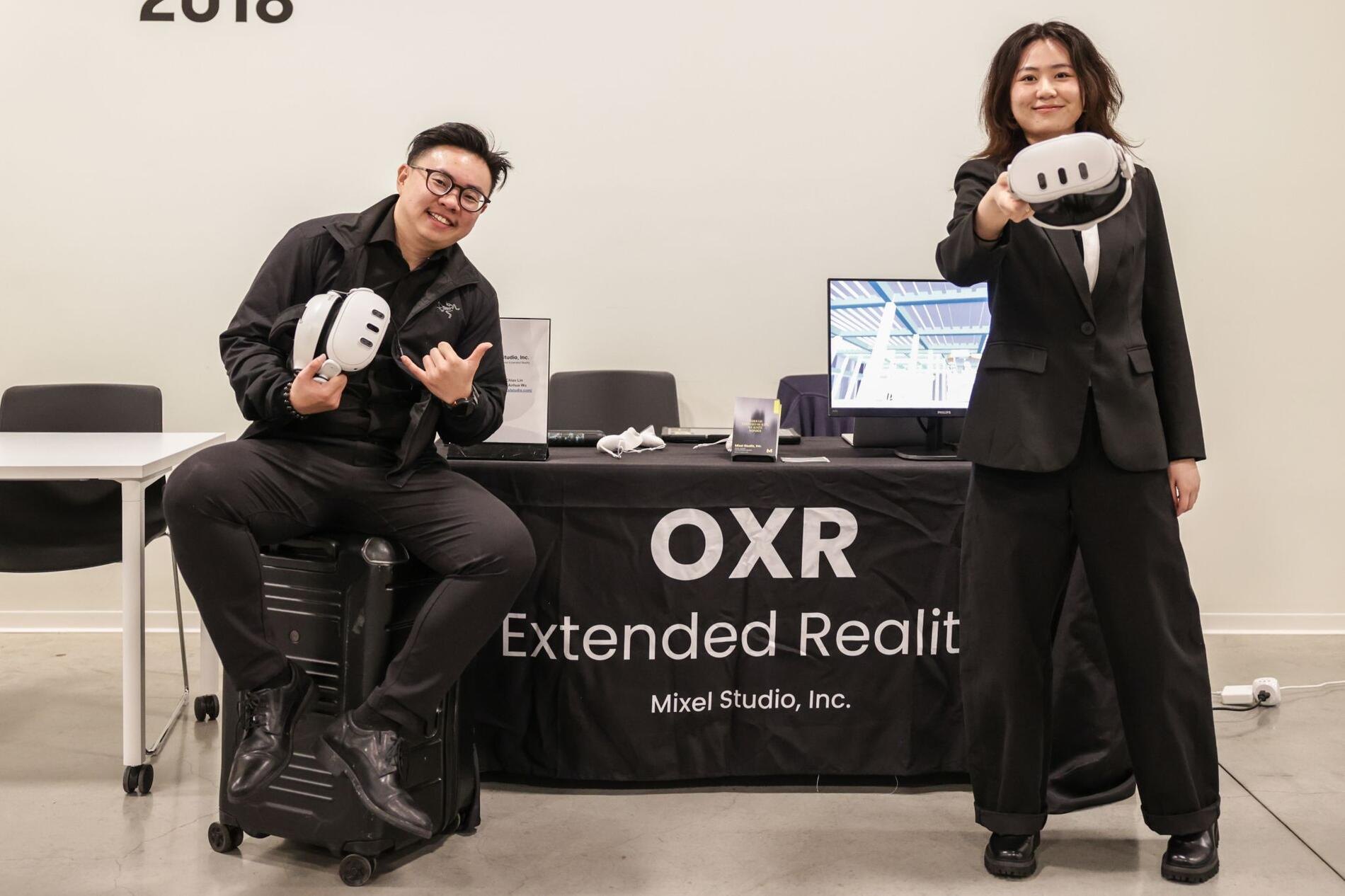
An Ann Arbor startup founded by two University of Michigan School of Information graduates has secured an exclusive worldwide license from U-M for technology that lets teachers lead immersive extended-reality lessons without writing a line of code.
Mixel Studio, co-founded by CEO Chiao Lin and CTO Anhua Wu, executed the software and patent license agreement with the Regents of the University of Michigan through U-M Innovation Partnerships in July 2026, according to a company announcement. A U.S. provisional patent application for the underlying technology was filed April 10, 2026.
The company's flagship product, OXR, is a spatial presentation platform that allows an instructor to guide an entire class through a synchronized XR experience. Students can follow along on headsets, web browsers or mobile devices. Lin told UMSI in an Aug. 18 feature that the platform solves a practical gap: "Schools couldn't adopt this, not necessarily because they don't have money for the technology. Many schools have headsets. The problem is that teachers can't easily use them for teaching. No one knew how to bring XR into an entire classroom."
The licensed technology, developed by the founding team in collaboration with associate professor Michael Nebeling, uses a multi-device orchestration architecture that lets a presenter coordinate connected XR experiences in real time while assigning different roles and control levels to participants on different devices.
From hackathon to venture backing
Lin first competed at MIT's Reality Hack in January 2024, where his team earned an honorable mention for a block-based coding concept in mixed reality. That project evolved into CodeBloc, and then into OXR after the team discovered a scalability problem: without one facilitator per student, teachers couldn't guide an entire class through a headset experience at once.
In April 2025, OXR won the $10,000 grand prize at U-M's James A. Kelly Learning Lever Prize competition for educational technology. Lin incorporated Mixel Studio that same month. Wu officially joined as co-founder and CTO in July 2025, and OXR 1.0 launched in early October 2025.
As of its Union Heritage Ventures deal in July 2026, Mixel Studio had secured three rounds of institutional investment, according to the company: from U-M's Zell Founders Fund through the Desai Accelerator, from MSU Research Foundation's Red Cedar Ventures through the Conquer Accelerator, and from Union Heritage Ventures itself. Mixel Studio also received $15,000 in non-dilutive funding after being selected for the Michigan Founders Fund Pre-Accelerator in winter 2026, chosen from 122 applicants. OXR was also nominated as a finalist for Best Content Creation Tool at the 2026 AWE Auggie Awards.
Early pilots show traction
OXR has been piloted at U-M's Marsal Family School of Education, where 100% of students in a course taught by clinical associate professor Rebecca Quintana successfully designed and delivered XR lessons with minimal training. Topics ranged from Turkish coffee making to automotive safety.
At Detroit Country Day School, 80% of participants said OXR was effective for learning and 90% were satisfied with the lesson format.
The company targets K-12 schools, universities, museums, workforce training programs and healthcare settings. Its strategy focuses on making spatial computing accessible across devices without requiring organizations to buy a single type of hardware.
Most recently, Mixel Studio joined U-M's Desai Accelerator Class of 2026 — a separate four-month cohort program that includes a new $25,000 investment, mentorship and strategic resources.