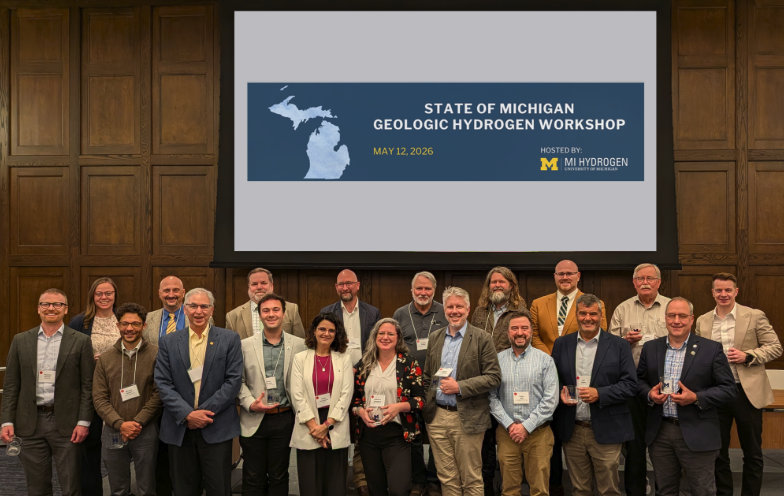
Michigan is spending $7.5 million to find out whether a carbon-free fuel is trapped in rock formations deep below the state, and a University of Michigan researcher is helping lead the search.
The Michigan Infrastructure Office announced the seed funding for geologic hydrogen exploration, according to Michigan Public. The money will pay for scientific research, underground mapping and test well drilling to determine whether hydrogen exists in commercially meaningful quantities beneath Michigan.
Brian Ellis, an associate professor of civil and environmental engineering at U-M and co-director of the research collaboration MI Hydrogen, called the field "highly speculative" but said it has tremendous potential for unlocking a carbon-free gas to power transportation and manufacturing.
"This is a good time to be making investments in this science, trying to figure out whether Michigan really has the resource potentially existing below our feet, and can we go out and find it," Ellis told Michigan Public.
Why Michigan
Geologic hydrogen forms deep underground when water interacts with iron-rich rock or when water molecules are exposed to radioactive decay. Michigan sits over part of the Mid-Continent Rift, a billion-year-old geologic feature that may have produced the right rock formations to generate hydrogen and seal it underground.
The U.S. Geological Survey released a prospectivity map of the lower 48 states identifying likely locations for geologic hydrogen deposits. Michigan's rift geology placed it among the prime candidates.
Unlike petroleum, burning hydrogen produces only water as a byproduct. If the deposits prove commercially viable, the state's executive directive estimates they could generate tens of millions of dollars annually in direct state revenue.
The money
The $7.5 million comes from the Make It in Michigan Competitiveness Fund. The funding will also serve as matching money as the state pursues additional grants from the U.S. Department of Energy and other federal agencies.
Planned work includes partnerships with national laboratories, universities, research institutions and private-sector organizations. The state said findings will be released publicly as research progresses.
The initiative is real money, but not unprecedented. Including this investment, the Competitiveness Fund has put $200.5 million to work and helped leverage about $1 billion in federal funding.
Background
The funding follows Gov. Gretchen Whitmer's Executive Directive No. 2026-1, signed Jan. 15, which established the Michigan Geologic Hydrogen Exploration and Preparedness Initiative. The directive assigned action items to the Department of Environment, Great Lakes, and Energy; the Department of Natural Resources; and the Michigan Infrastructure Office, with deliverables originally due by April 1.
When signing the directive on Jan. 15, Whitmer said the initiative would uncover more about Michigan's hydrogen stores and has the potential to attract long-term investments and create thousands of jobs.
MI Hydrogen, the U-M collaboration Ellis co-directs, brings together university researchers, community groups, government and industry partners to develop strategies for clean energy. The state is seeking federal matching funds from the Department of Energy to expand the exploration effort.