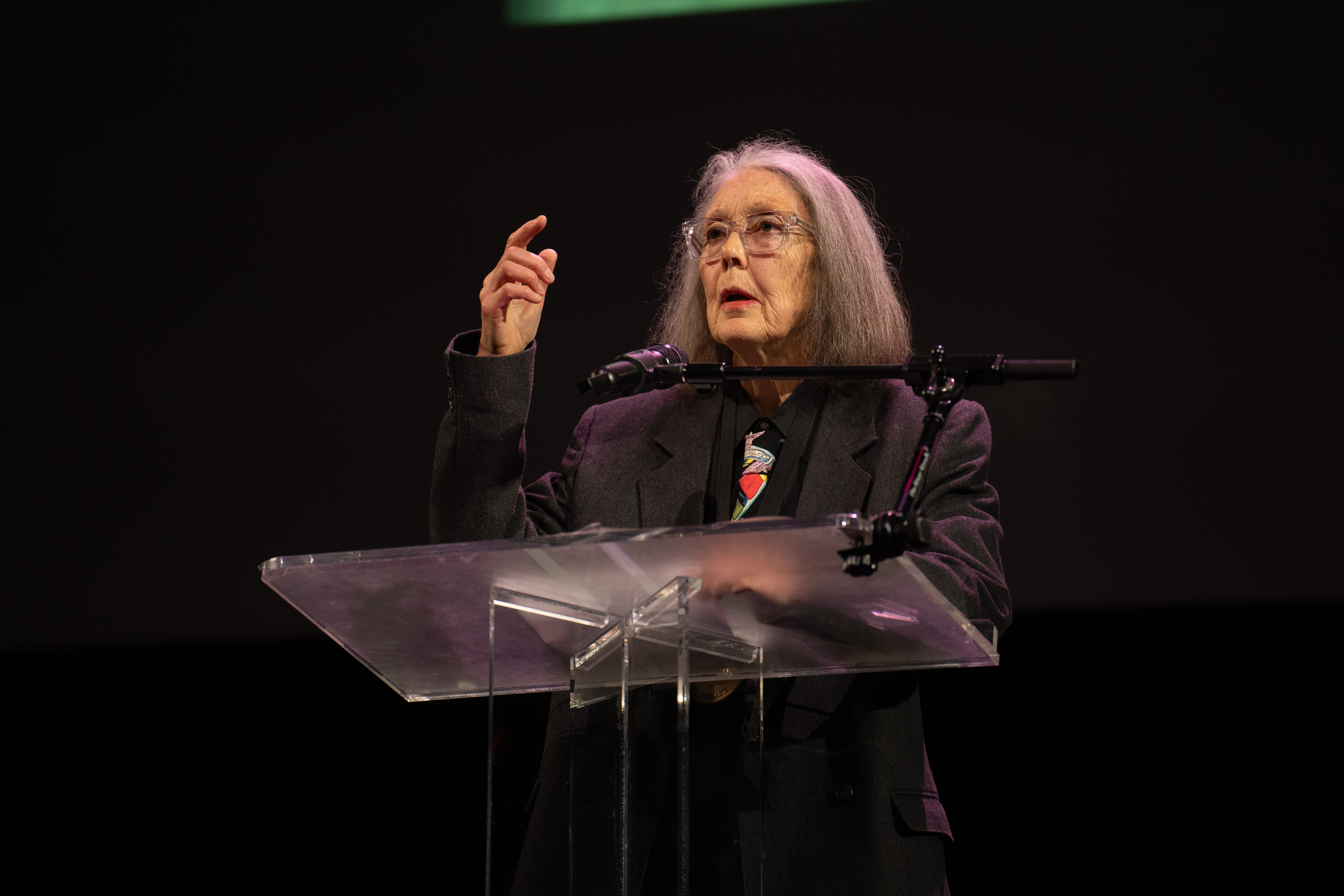
Anne Carson, the Canadian poet and classicist who taught at the University of Michigan for six years, won the 2026 Nobel Prize in Literature on Thursday, Oct. 8.
The Swedish Academy honored Carson "for her bold and inventive oeuvre that, in playful dialogue with the classical tradition, has created new forms for contemporary literature," according to the Nobel Prize announcement. The prize carries a cash award of approximately $1.2 million.
Carson served as professor of classical studies, comparative literature, and English language and literature at U-M from 2003 to 2009, according to the Ann Arbor Observer. She had earlier held the Norman Freehling Visiting Professorship at the university in 1999–2000.
The 76-year-old was in Iceland when she learned of the prize. She told Icelandic broadcaster RUV: "Crazy. I think they're all crazy … Well, you know, it's crazy," Al Jazeera reported.
Born in Toronto in 1950, Carson earned her doctorate in classics from the University of Toronto in 1981. She has taught at the University of Calgary, McGill University, New York University and Princeton University in addition to U-M. At NYU, she spent 13 years as distinguished writer in residence, where she and her partner and collaborator, Robert Currie, taught a graduate workshop called "Egocircus," Inside Higher Ed reported.
Carson has written more than 20 books. Her 1998 novel-in-verse "Autobiography of Red," a reimagining of a Greek myth as a love story, has sold nearly 100,000 copies in the United States, according to publisher Knopf, as Publishers Weekly reported. Her most recent book, "Wrong Norma," won the 2024 National Book Critics Circle Award and was a National Book Award finalist. New Directions will publish her next book-length essay, "Beware the Man Whose Handwriting Sways Like a Reed in the Wind," in February 2027.
She became the first woman to win the 2001 T.S. Eliot Prize. She is the 19th woman and third Canadian-born writer to receive the Nobel Prize in Literature, following Alice Munro in 2013 and Saul Bellow in 1976, according to the University of Toronto.
Nobel Committee chair Anders Olsson said Carson's work centers on "the intersection between the philologist's obsession with words and the poet's desire for new meaning," Inside Higher Ed reported. The wording also appears in the Swedish Academy’s biography.
In August 2024, Carson revealed in the London Review of Books that she was living with Parkinson's disease.
U-M President Domenico Grasso praised Carson’s work as a teacher and mentor in a university news release, the Detroit Free Press reported Oct. 8.